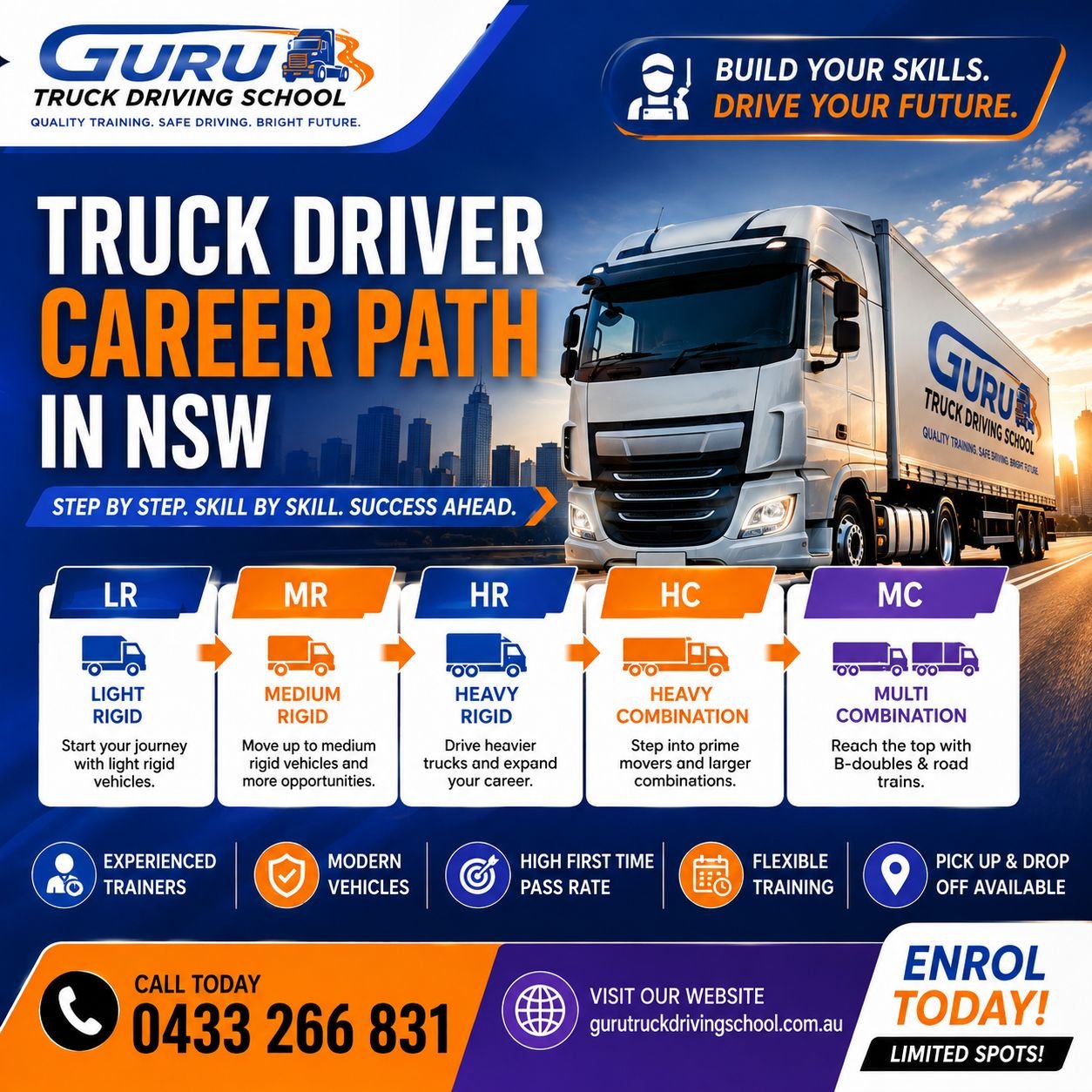
Thinking about becoming a truck driver in NSW but not sure where to start?
The truck driver career path in NSW can look confusing when you see licence classes such as LR, MR, HR, HC and MC. The good news is that you do not need to understand everything at once.
You can build your career step by step, starting with the licence that matches your current experience and the type of work you want to do.
The usual heavy vehicle licence hierarchy in NSW is:
LR → MR → HR → HC → MC
However, you do not always need to collect every licence along the way. Your best pathway depends on your current licence, driving experience and career goals.
In this guide, we explain each stage and what you can expect as you move towards professional truck driving.
What Is the Truck Driver Career Path in NSW?
The truck driver career path is the process of gaining the right heavy vehicle licence, building driving experience and progressing to larger or more specialised vehicles.
NSW has five heavy vehicle licence classes:
- LR – Light Rigid
- MR – Medium Rigid
- HR – Heavy Rigid
- HC – Heavy Combination
- MC – Multi Combination
NSW Government describes MC as the highest heavy vehicle licence class. Each class has its own eligibility requirements, and you can generally drive vehicles covered by lower licence classes once you hold a higher class.
The important point is that your career does not have to follow exactly the same path as another driver.
For example, one person may start with LR and move to MR, while another may aim for HR as their first heavy vehicle licence once eligible.
Step 1: Start With Your Car Licence
Before moving into heavy vehicles, most drivers begin with a NSW Class C licence.
Your existing licence history is important because NSW has minimum tenure requirements for heavy vehicle licences.
For example:
- LR requires at least 1 year holding a Class C licence or equivalent.
- MR requires at least 1 year holding a Class C licence or equivalent.
- HR requires at least 2 years holding a Class C licence or equivalent.
- HC requires at least 1 year holding an MR or HR licence or equivalent.
- MC requires at least 1 year holding an HR or HC licence or equivalent.
So, your first step is to check your current licence and determine which heavy vehicle class you are eligible for.
Step 2: LR Licence – Light Rigid
LR stands for Light Rigid.
It is one of the entry points into heavy vehicle driving and covers smaller rigid trucks and certain buses.
An LR vehicle can include a truck with a GVM up to 8 tonnes, with specific trailer limits applying.
What jobs can you do with an LR licence?
Depending on the employer and vehicle, LR drivers may find work in areas such as:
- Local deliveries
- Small transport businesses
- Commercial deliveries
- Service businesses
- Some passenger transport roles
LR can be a good option if you want to gain your first heavy vehicle experience without immediately moving into a larger truck.
However, if your long-term goal is to become a professional heavy combination or interstate driver, you may want to plan your licence progression before choosing your first course.
Step 3: MR Licence – Medium Rigid
MR stands for Medium Rigid.
An MR licence allows you to operate rigid vehicles with two axles and a GVM above 8 tonnes, subject to NSW licence conditions.
MR can be useful for drivers interested in:
- Delivery trucks
- Freight
- Logistics
- Commercial transport
- Medium-sized rigid vehicles
For some drivers, MR is a natural next step after LR.
For others, it may not be necessary if their career goal is to move towards HR and eventually HC.
Step 4: HR Licence – Heavy Rigid
HR stands for Heavy Rigid and is an important milestone for many people building a truck driving career.
A NSW HR licence covers heavy rigid vehicles with three or more axles and a GVM above 8 tonnes. It can also cover articulated buses.
HR can open the door to a wider range of heavy vehicle driving jobs.
These can include:
- Heavy rigid truck driving
- Freight transport
- Construction
- Waste collection
- Local distribution
- Delivery work
- Bus driving, where the relevant requirements are met
For someone who wants a long-term career in trucking, HR can be an important foundation.
How long do I need a car licence before HR?
Under current NSW requirements, you generally need to have held a Class C licence or equivalent for at least 2 years to apply for HR.
This is one reason why planning your career early can be useful.
If you are already eligible for HR, you may not need to obtain LR and MR first.
Step 5: HC Licence – Heavy Combination
HC stands for Heavy Combination.
This is where your career can move from rigid trucks into combination vehicles.
HC vehicles can include articulated vehicles with three or more axles and certain heavy rigid vehicle and trailer combinations.
For many drivers, moving from HR to HC is a major career step.
What can you do with an HC licence?
HC drivers may work in:
- Freight transport
- Logistics
- Interstate transport
- Distribution
- Prime mover and semi-trailer operations
- Long-distance driving
- General road transport
An HC licence can therefore provide a different range of opportunities compared with an HR licence.
Guru Truck Driving School provides HC training in NSW, including practical training for drivers moving into heavy combination vehicles.
How do you upgrade from HR to HC?
Under current NSW rules, you generally need to have held an MR or HR licence for at least 1 year before applying for HC. If you hold a provisional P2 MR or HR licence, that tenure can be recognised, but you must hold an unrestricted MR or HR licence before learning to drive or upgrading to HC.
Step 6: MC Licence – Multi Combination
MC stands for Multi Combination and is the highest heavy vehicle licence class in NSW.
An MC licence allows drivers to operate vehicles such as:
- B-doubles
- Road trains
- Prime mover and multi-combination setups
- Certain low-loader combinations
NSW Government confirms that MC is the highest heavy vehicle licence class.
For drivers who want to work in specialised, long-distance or multi-combination transport, MC can be an important career goal.
What do you need for an MC licence?
You generally need to have held an HR or HC licence for at least 1 year.
There are also additional assessment and medical requirements.
If you hold HR and want to progress to MC, NSW requires you to complete an HC assessment before starting MC training. MC applicants must complete the Heavy Vehicle Competency Based Assessment (HVCBA).
Guru Truck Driving School also provides MC training for drivers looking to progress into multi-combination driving.
Truck Driver Career Path NSW: At a Glance
| Licence | What It Means | Possible Career Direction |
|---|---|---|
| LR | Light Rigid | Local delivery and smaller commercial vehicles |
| MR | Medium Rigid | Medium freight and delivery |
| HR | Heavy Rigid | Heavy trucks, freight, construction and distribution |
| HC | Heavy Combination | Prime movers, semi-trailers and freight |
| MC | Multi Combination | B-doubles, road trains and specialised transport |
Remember that these are general career directions. The actual vehicle you can drive depends on your licence class and the applicable NSW rules.
Do You Have to Get LR → MR → HR → HC → MC?
No.
This is one of the biggest misunderstandings about the truck driver career path in NSW.
The licence system has a hierarchy, but you do not necessarily have to obtain every class.
For example, if you have the required Class C licence tenure and meet the other requirements, you may be eligible to apply for HR without first holding LR and MR.
Similarly, you may progress from HR to HC and then MC when you meet the required tenure and assessment requirements.
Your best pathway depends on the type of driving job you want.
Which Truck Licence Is Best for Your Career?
There is no single answer.
Choose LR if:
- You want to start with smaller rigid vehicles.
- Your target job only requires an LR licence.
- You want an introduction to heavy vehicle driving.
Choose MR if:
- You want to operate medium rigid vehicles.
- You are interested in delivery and freight work.
- MR matches the vehicle required by your target employer.
Choose HR if:
- You want to drive larger rigid trucks.
- You want more heavy vehicle career options.
- You are interested in construction, freight, waste or distribution.
- You eventually want to progress to HC.
Choose HC if:
- You want to drive a prime mover and semi-trailer.
- You want to move into freight or long-distance work.
- You want to progress towards MC.
Choose MC if:
- You want to operate B-doubles or road trains.
- You are interested in specialised heavy transport.
- Your long-term career goal requires the highest heavy vehicle licence class.
How to Build a Truck Driving Career in NSW
Getting your licence is only one part of becoming a professional truck driver.
A strong career is built through a combination of:
1. Correct Licence
Make sure your licence matches the vehicle you plan to drive.
2. Professional Training
Good training helps you understand vehicle controls, road positioning, reversing, braking, blind spots and safe heavy vehicle operation.
3. Real Driving Experience
After getting your licence, experience is extremely valuable.
Spend time developing confidence in:
- Urban traffic
- Narrow roads
- Intersections
- Reversing
- Loading areas
- Highway driving
- Different weather conditions
- Heavy traffic
4. Safety Knowledge
Truck drivers have greater responsibilities because heavy vehicles require more space and generally have longer stopping distances.
Understanding load restraint, fatigue management, vehicle checks and safe driving practices is an important part of professional trucking.
5. Career Planning
Think beyond your first licence.
Ask yourself:
Where do I want to be in 2 years?
Maybe your goal is HR.
Where do I want to be in 5 years?
Perhaps HC or MC.
Having a goal can help you choose training and employment opportunities that support your long-term career.
How Do You Upgrade Your Truck Licence?
When you are ready to move to the next licence class, you need to check the eligibility requirements for that class.
You will generally need to:
- Check your licence tenure.
- Pass the relevant Heavy Vehicle Knowledge Test.
- Meet eyesight requirements.
- Complete the required training or assessment.
- Complete the HVCBA or applicable driving test.
- Apply for the upgraded licence through Service NSW.
NSW has separate Heavy Vehicle Knowledge Tests for rigid licences (LR, MR and HR) and combination licences (HC and MC).
The HVCBA is the primary pathway for obtaining a heavy vehicle licence in NSW, and MC applicants must complete HVCBA.
Why Choose Professional Truck Licence Training?
Learning to drive a heavy vehicle is different from learning to drive a car.
A professional trainer can help you develop skills such as:
- Pre-start vehicle checks
- Safe gear selection
- Steering control
- Reversing
- Turning
- Lane positioning
- Braking
- Blind spot awareness
- Coupling and uncoupling for combination vehicles
- Assessment preparation
The aim should not simply be to pass the test.
The aim is to become a driver who can safely handle the vehicle in real working conditions.
Start Your Truck Driver Career With Guru Truck Driving School
If you are planning your truck driver career in NSW, choosing the right training provider can make the process easier to understand.
Guru Truck Driving School provides training across several heavy vehicle licence classes and helps students choose a licence pathway based on their current experience and career goals. The school currently lists LR, MR, HR, HC and MC training options.
You can check the available truck licence training and prices before booking.
If HR is your next step, you can also learn more about HR Heavy Rigid licence training.
For drivers ready to move from rigid trucks to combination vehicles, see the HC driving course in NSW.
For experienced drivers planning the final stage, Guru also offers MC licence training.
Frequently Asked Questions
What is the truck driver career path in NSW?
The heavy vehicle licence hierarchy in NSW is LR, MR, HR, HC and MC. However, drivers do not necessarily need to obtain every licence class. Eligibility depends on your existing licence and the requirements for the class you want.
Can I go straight from a car licence to HR?
If you meet the NSW eligibility requirements, you may be able to apply for HR without first obtaining LR and MR. Current NSW rules require at least 2 years of Class C or equivalent licence tenure for HR.
Do I need HR before HC?
You need to have held an MR or HR licence for at least 1 year to be eligible for HC under the current NSW requirements.
Can I get an MC licence after HR?
Yes, but there are additional requirements. You generally need to have held HR or HC for at least 1 year. If you hold HR, you also need to pass an HC assessment before starting MC training.
Which licence is best for a truck driving career?
It depends on the type of work you want. HR can be a strong option for heavy rigid work, HC is useful for semi-trailer and freight driving, while MC is designed for multi-combination vehicles such as B-doubles and road trains.
How long does it take to become a truck driver in NSW?
There is no single timeframe. Your eligibility, current licence, training needs and assessment requirements all affect how quickly you can progress.
Is truck driving a good career in NSW?
Truck driving can provide career opportunities across freight, logistics, construction, waste management, delivery and long-distance transport. The licence you choose should match the type of driving work you want to pursue.
Your Road to a Truck Driving Career Starts With the Right Licence
You do not need to plan your entire career in one day.
Start with your current licence.
Understand what you are eligible for.
Choose the licence that matches your career goal.
Then build your experience and progress when you are ready.
Whether your goal is HR, HC or MC, a professional training program can help you develop the practical skills and confidence needed for heavy vehicle driving.
If you are ready to take the next step, contact Guru Truck Driving School and discuss the right truck licence pathway for your career in NSW.
Book Your Training Today
Take the first step towards a rewarding career in transport and logistics. Contact Guru Truck Driving School today and learn from one of Australia’s most trusted heavy vehicle training providers.
Your future on the road starts here.
For Website Design & Development | SEO Optimization & Content | UI/UX Design
Contact : Reelcrafted | View Website | +91 9815081200