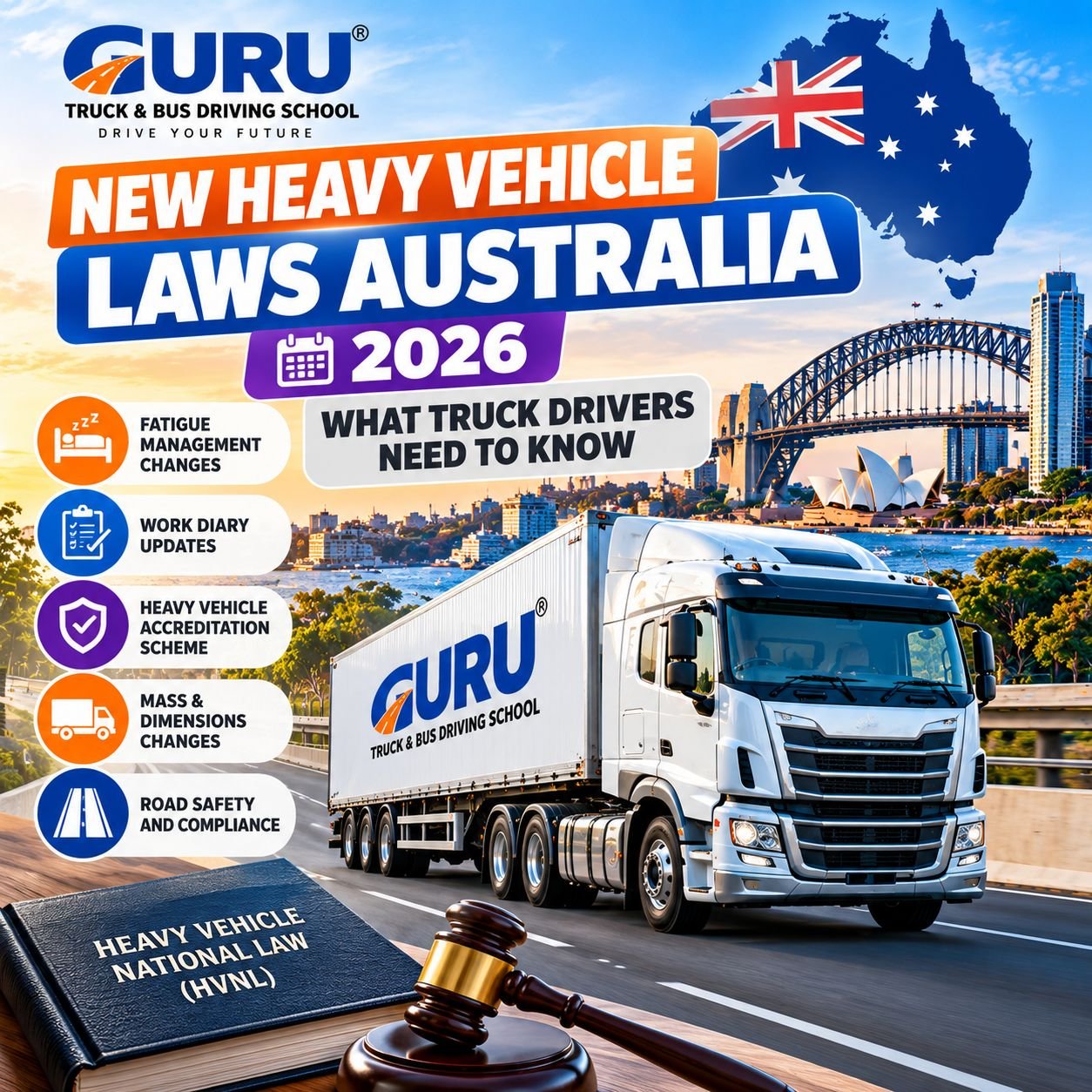
The new heavy vehicle laws in Australia for 2026 are important for truck drivers, transport operators and businesses that use heavy vehicles.
Changes to the Heavy Vehicle National Law (HVNL) took effect on 1 August 2026. The changes cover several areas, including fatigue management, work diaries, heavy vehicle accreditation, and vehicle mass and dimensions.
If you drive a truck or plan to start a career in the transport industry, it is worth understanding these changes before getting on the road.
In this guide, we explain the main changes in simple English, what truck drivers should know and why safe driving skills remain important.
For the official information, visit the National Heavy Vehicle Regulator (NHVR).
1. What Are the New Heavy Vehicle Laws in Australia?
New Heavy Vehicle Laws Australia 2026, The Heavy Vehicle National Law sets out many of the rules that apply to heavy vehicles in participating Australian states and territories.
The 2026 reforms updated parts of the law to support heavy vehicle safety, compliance and productivity.
The main areas of change include:
- Fatigue management and fitness to drive.
- Written work diary requirements.
- A new Heavy Vehicle Accreditation scheme.
- Safety management systems and audits.
- Vehicle mass, dimensions and loading rules.
These changes do not mean that every truck driver has the same new requirements. The rules that apply depend on the vehicle, the work being done and the driver’s or operator’s circumstances.
Drivers should check the official NHVR guidance before relying on general information.
2. Changes to Truck Driver Fatigue Rules
Fatigue is a serious road safety risk. A tired driver may react more slowly, lose concentration or fail to notice hazards.
The 2026 changes strengthen the focus on fitness to drive. Under the amended HVNL, a person must not drive a heavy vehicle over 4.5 tonnes gross vehicle mass while impaired by fatigue or otherwise unfit to drive.
This applies even if the driver is still within the permitted work and rest hours.
For truck drivers, this means it is important to pay attention to how you feel, not just what your work diary says.
Practical steps include:
- Get enough rest before starting a shift.
- Follow the work and rest hours that apply to your operation.
- Take required rest breaks.
- Speak up if you are too tired or unwell to drive safely.
- Never assume that being within your hours automatically means you are fit to drive.
You can read the official guidance on NHVR work and rest hours.
3. What Has Changed With Truck Driver Work Diaries?
A written work diary records a driver’s work and rest activities when a diary is required.
From 1 August 2026, changes were introduced to the way information is recorded in the Written Work Diary. Some entries that were previously mandatory have become optional under the updated diary instructions.
The updated diary also includes an option for drivers operating under Alternative Compliance Hours, where the relevant requirements apply.
However, drivers must still complete their work diaries correctly and follow the work and rest rules that apply to them.
If you drive a fatigue-regulated heavy vehicle, check which diary and hours option applies to your work. Do not assume that every field or rule is the same for every driver.
Read the official NHVR work diary guidance for the latest instructions.
4. What Is the New Heavy Vehicle Accreditation Scheme?
Another important change is the introduction of the Heavy Vehicle Accreditation (HVA) scheme.
The scheme introduces a new approach to accreditation, including General Safety Accreditation and Alternative Compliance Accreditation.
It places greater emphasis on a transport business’s overall safety management system. This includes how the business manages risks related to maintenance, fatigue, mass and other safety activities.
Existing operators may be covered by transitional arrangements, so the change does not mean every business must immediately switch in the same way.
For drivers, the practical message is to understand the requirements of the operation you work for. If you are an owner-driver or run a transport business, check your accreditation status and transition options with the NHVR.
You can find details on the NHVR Heavy Vehicle Accreditation changes.
5. Changes to Heavy Vehicle Mass and Dimensions
The reforms also include changes to some heavy vehicle mass and dimension provisions.
For example, the NHVR identifies an increase in the general heavy vehicle length limit from 19 metres to 20 metres, along with changes to mass limits and other operating provisions.
These changes do not mean that every truck can automatically operate at the new limits on every road. Vehicle type, road access conditions, approvals, permits and other restrictions may still apply.
Drivers and operators should confirm the requirements for their specific vehicle and route before using a different mass or dimension limit.
For the details, check the NHVR heavy vehicle law reform guide.
6. What Do These Law Changes Mean for New Truck Drivers?
If you are planning to become a truck driver, you do not need to become a transport law expert before you begin training. However, you should understand that professional truck driving involves more than controlling a vehicle.
A responsible driver needs to understand road rules, vehicle safety, hazard awareness and the responsibilities that come with operating a heavy vehicle.
Practical training can help you build skills such as:
- Checking the vehicle before driving.
- Maintaining safe following distances.
- Using mirrors and managing blind spots.
- Positioning the truck correctly on the road.
- Recognising hazards early.
- Following speed limits and road signs.
- Driving safely in different traffic conditions.
These skills are useful whether you are new to truck driving or working towards a higher licence class.
If you are starting out, read our complete NSW truck licence guide to understand the different licence classes and training pathways.
7. Why Safe Driving Training Matters
The new heavy vehicle laws Australia introduced in 2026 highlight the importance of safety and responsible driving.
A licence is an important starting point, but drivers also need good habits and the ability to make safe decisions on the road.
Training can help learners understand vehicle control, observation, road positioning and safe driving techniques. It can also help them prepare for the practical assessment required for their chosen licence class.
At Guru Truck & Bus Driving School, learners can explore training options for different heavy vehicle licence classes.
If you want to work towards an HR licence, visit our HR Heavy Rigid Truck Licence page.
For more information about the school and available training, visit the Guru Truck & Bus Driving School website.
8. A Simple Checklist for Truck Drivers
To stay informed and drive responsibly, use this checklist:
- Check the current rules that apply to your vehicle and work.
- Follow your required work and rest hours.
- Do not drive if fatigue or illness makes you unfit to drive.
- Complete your work diary correctly when one is required.
- Check vehicle mass, dimensions and road access conditions.
- Follow your employer’s safety procedures.
- Keep up with official NHVR updates.
If you operate your own transport business, also check whether the new accreditation arrangements affect your business and whether transitional provisions apply.
Frequently Asked Questions
When did the new heavy vehicle laws start in Australia?
The amended Heavy Vehicle National Law and associated changes took effect on 1 August 2026.
Do the new laws affect all truck drivers?
The reforms cover several areas of heavy vehicle operation, but the specific requirements depend on the vehicle, work, hours option and other circumstances. Drivers should check the NHVR’s official guidance.
Can I drive if I am within my work hours but feel tired?
No. A driver must not drive a heavy vehicle over 4.5 tonnes GVM while impaired by fatigue or otherwise unfit to drive, even when within permitted work and rest hours.
Have truck driver work diary requirements changed?
Yes. From 1 August 2026, some entries in the Written Work Diary became optional under the updated instructions. Drivers must still record the required information and follow the applicable work and rest rules.
Do the new laws change truck licence requirements?
The reforms cover heavy vehicle regulation, accreditation, fatigue, work diaries and mass and dimensions. They do not replace the need to hold the correct licence for the vehicle you drive. Check the relevant state or territory licensing authority for licence requirements.
Where can I learn about truck licence training in NSW?
You can explore the Guru Truck & Bus Driving School truck licence guide or contact the school to discuss training options for your licence goals.
Final Thoughts
The new heavy vehicle laws Australia introduced in 2026 are an important reminder that safety and compliance are part of professional truck driving.
Drivers should understand the rules that apply to their work, follow fatigue requirements, complete their records correctly and check vehicle limits before operating.
If you are planning to enter the transport industry, start by choosing the correct truck licence pathway and developing safe driving skills.
Visit Guru Truck & Bus Driving School to explore training options and take the next step towards your truck driving goals.
Important: This article is a general guide, not legal advice. Heavy vehicle requirements can depend on your vehicle, work arrangements and location. Always check the latest official NHVR and state or territory guidance before making operational decisions.
Ready to Start?
Take the first step towards a rewarding career in transport and logistics. Contact Guru Truck Driving School today and learn from one of Australia’s most trusted heavy vehicle training providers.
Your future on the road starts here.

For Website Design & Development | SEO Optimization & Content | UI/UX Design
Contact : Reelcrafted | View Website | +91 9815081200